Making sense of the unwritten rules of work.
Competence doesn't always speak for itself.
“Be more visible.” “Speak up more.” “Show more confidence.”
Apparently, doing good work is only part of the job. You also have to communicate it in ways that other people recognise as competent.
And those expectations aren't always obvious — particularly if you're quiet, introverted, neurodivergent, or simply someone whose best thinking doesn't come with a built-in confidence performance.
But there's another side to this: managers don't always realise which unwritten rules they're reinforcing, or how those rules affect the people they work with.
I'm a communication professor, former advertising creative, and late-identified neurodivergent writer. I explore the unwritten rules shaping whose ideas get heard, whose work gets recognised, and what counts as ‘professional’.
Through research-informed writing, books, and practical tools, I help professionals navigate those rules — and managers make them clearer, fairer and more inclusive.
No personality makeover. No positivity pep-talks. And definitely no power-posing.
New here? Start with the free Unwritten Rules Audit — a short PDF workbook to help you identify the unspoken expectations shaping your workplace.
Glad you’re here,

Different problems call for different kinds of support:
Maybe you have a presentation coming up and your nervous system has other plans. Maybe you've received feedback that sounds important but explains remarkably little. Or perhaps you're wondering why good work goes unrecognised — or how to create a workplace where different minds can do their best work.
You'll find research-informed books, practical tools and opportunities to work through these questions with me.
No twelve-week transformation required. Just choose what might be useful right now.
BOOKS
Check out my research-informed books about the hidden rules of workplace communication, presenting, and navigating professional life when the standard playbook doesn't quite fit.
Start with Presenting Without Panic or get a sneak peek of Off-Script At Work, which will be released in 2027.

TOOLS & RESOURCES
Practical workbooks, guides and resources for navigating the unwritten rules of working life — and helping others do the same.
From presentations and tricky feedback to meetings, workplace dynamics and inclusive management, each tool tackles a specific challenge with clear explanations and practical next steps.

ONE-TO-ONE
Sometimes a book or workbook isn’t quite enough.
Off-Script 1:1 is a four-session mentoring package for making sense of a communication, presentation or workplace challenge — and working out what might actually help in your particular context.
SPEAKING & CONVERSATIONS
I speak with organisations, teams, conferences and podcasts about communication, creativity, workplace culture, neurodivergence — and the invisible rules connecting them.
Research-informed, practical, and with considerably fewer motivational slogans than the industry average.

Two problems nobody ever solved by trying to be “just a little bit more confident”.
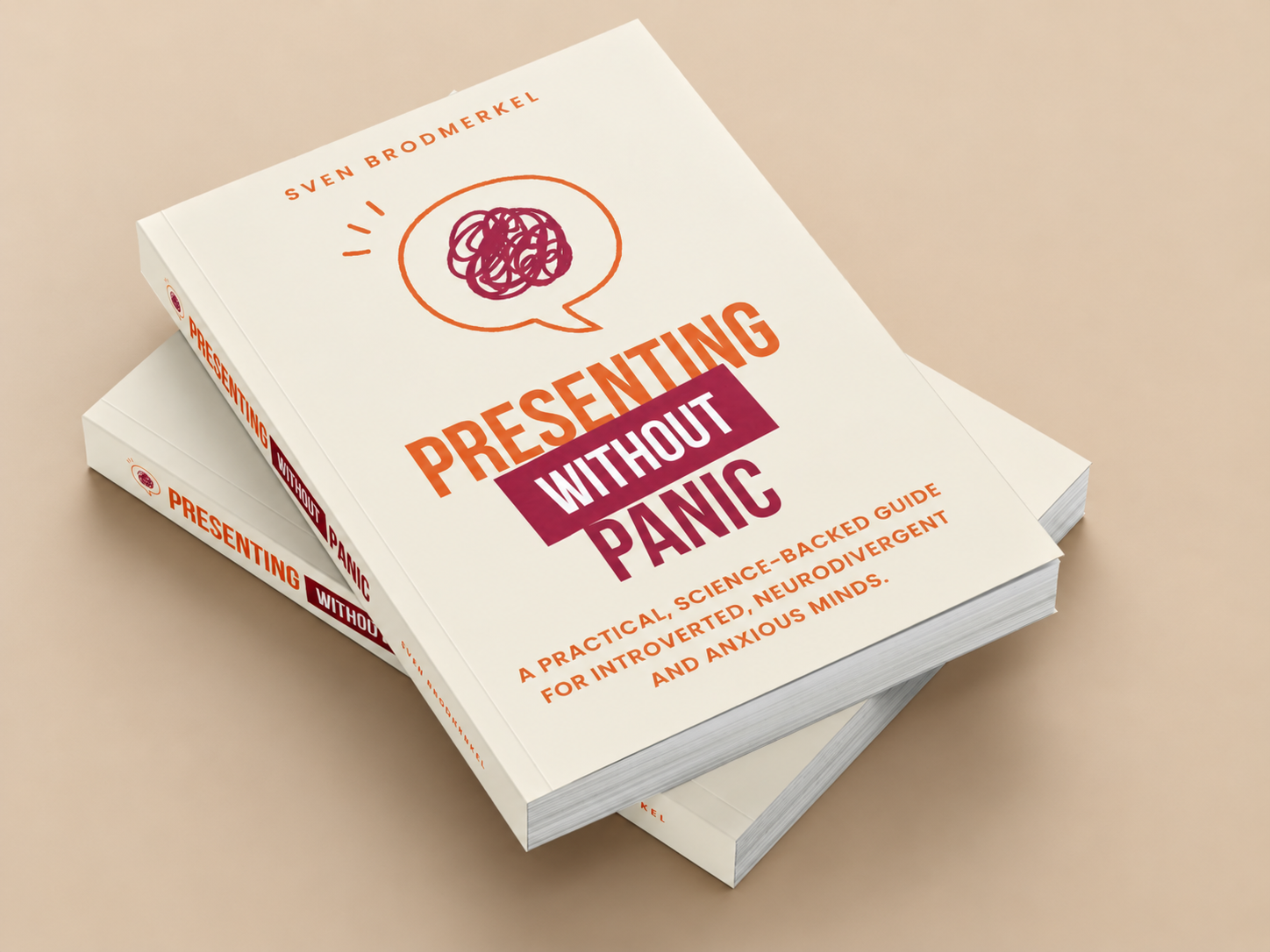
PRESENTING WITHOUT PANIC
When you know your material but your nervous system has other plans.
“Just imagine the audience in their underwear” was never particularly helpful.
Most public-speaking advice starts with performance: posture, polish, projection and confidence.
Presenting Without Panic starts somewhere else — with what actually happens when your nervous system detects a threat.
Drawing on sports psychology, mindfulness and Acceptance and Commitment Therapy (ACT), this practical field guide offers something more durable than a superficial confidence makeover.
You'll find practical frameworks, tools and exercises to help you manage speaking anxiety, think more clearly under pressure and structure your ideas in ways that are easier to hold onto when your heart rate has other ideas.
No forced positivity. No personality makeover. And no requirement to become the most charismatic person in the room.

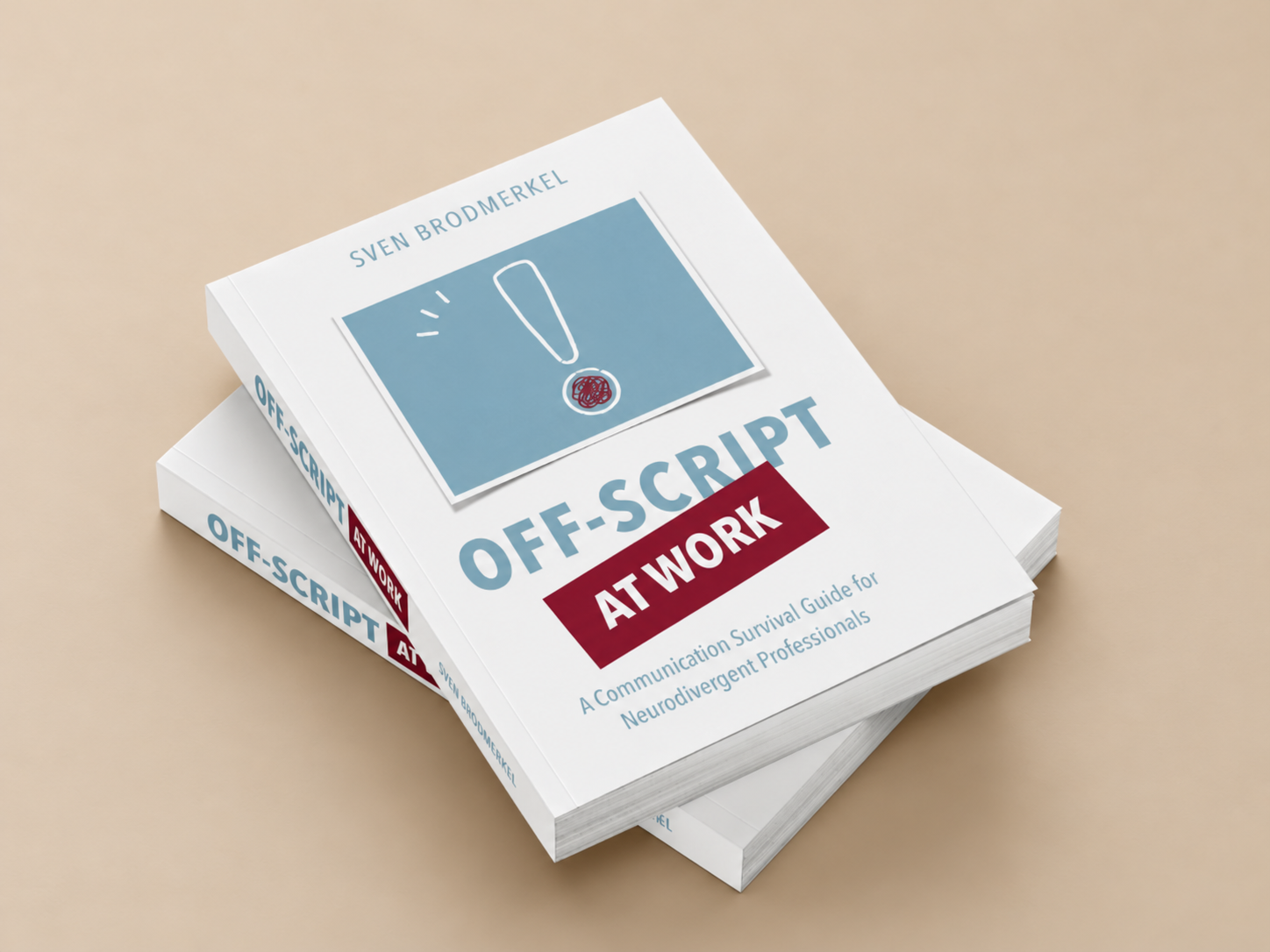
OFF-SCRIPT AT WORK
Work is the easy part. Communication is where it gets complicated.
Professional life comes with an extraordinary number of rules nobody actually explains.
How to disagree. How to give feedback. How confident to sound. When to speak. How much context is too much context. What “professional” means. How to read a room that apparently everyone else received instructions for.
Off-Script At Work makes some of those rules visible.
Drawing on communication research, neurodivergent perspectives and a healthy scepticism of workplace mythology, it explores the gap between how communication officially works and what actually happens.
Why feedback becomes confusing. Why good ideas don't always travel. Why some communication styles are recognised as competent more readily than others. And what becomes possible when you stop assuming that every communication mismatch is a personal deficit.
The book also introduces four different processing and communication patterns, along with practical frameworks for navigating the gap between how you think and how you're heard.

Tools & Resources:
Something practical for the problem you have right now.
I got feedback. But what does it actually mean?
The Feedback Decoder
“You need to be more visible.” “Appear more confident.” “Show more executive presence.” What?
This kit helps you decode vague feedback, ask better questions and decide what to do next — without automatically assuming the problem is you.
Fillable PDF | 18 pages | AUD 13
I had something to say.
The moment passed.
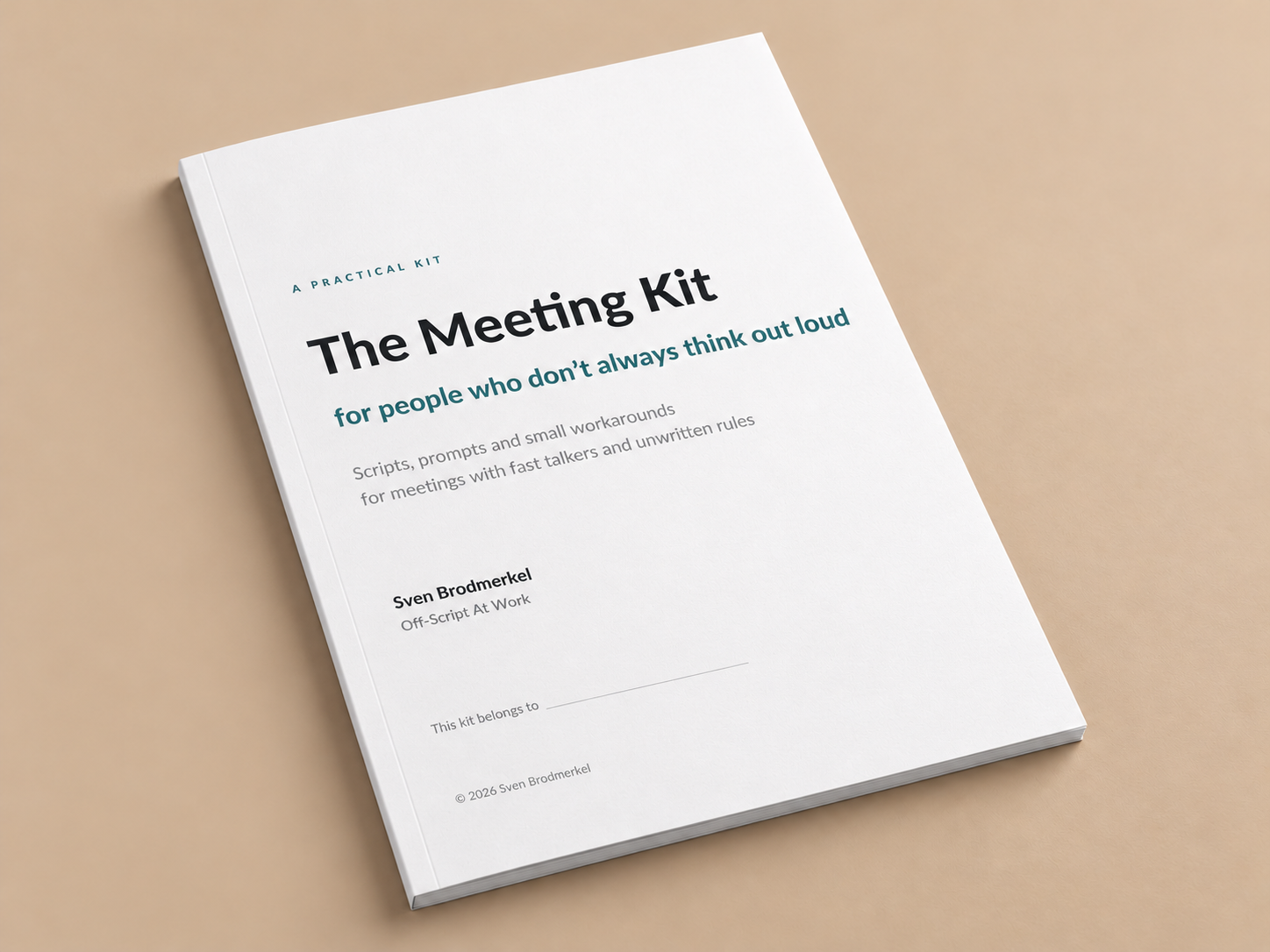
The Meeting Kit for Quiet Thinkers
Meetings tend to reward whoever can think out loud fastest. If that isn’t you, “just speak up more” isn’t particularly useful advice.
This kit gives you practical strategies and workarounds for asking for time, contributing your ideas and following up afterwards — without having to become someone who thinks out loud.
. Fillable PDF | 19 pages | AUD 13

Speaking knocks me
off-centre.
Find Your Centre of Gravity
Most presentation advice tells you what to do.
This short reflection workbook asks some better questions first: how do you think? What throws you off? What helps you regain your footing? And where is your steadiest ground when pressure rises?
. Fillable PDF | 15 pages | FREE
Looking for something else?
The Digital Store contains practical tools for communicating, presenting and navigating professional life with a little less guesswork.
Off-Script 1:1
The Four-Session Mentoring Package
For professionals who want to work through a recurring communication or workplace challenge in more depth.
That might be:
A communication pattern that keeps causing friction
Making your ideas land without performing a version of yourself that isn't sustainable
Unwritten expectations in a new role, team or workplace
Navigating communication differences, competing needs or misunderstandings within your team
Rethinking how you give feedback, recognise contributions or create space for different people to participate
An important conversation, presentation or decision coming up
The aim isn't to turn you into a different kind of communicator — or a different kind of manager. It's to understand what's actually happening, which rules or assumptions are operating, and what might work in your particular context.
How it works
Four 60-minute sessions:
See the Script. Separate what’s happening from what you’re assuming, and spot the unwritten rules shaping the problem.
Decode the Rules. Look for patterns and mismatched expectations in the norms around you.
Navigate Deliberately. Test practical ways to clarify, adapt, question or communicate differently.
Build Your Playbook. Pull together what worked into scripts and experiments you can use beyond our sessions.
Between sessions, you’ll try light-touch experiments in real situations.
What’s included
Four 60-minute individual sessions
A short pre-session intake
Between-session experiments, with Off-Script reflection tools
Your Personal Off-Script Playbook
Investment: AUD 1,250.
Places are limited, so the work stays genuinely individual. No generic confidence formulas, no personality makeover, and no assumption that every communication problem is yours to fix.
Not sure it’s the right fit? Send me a short note about what’s going on. I’ll tell you honestly whether I think I can help.

The Unwritten Rules Audit
A short, reflective exercise for spotting the invisible rules shaping communication at your workplace.
Every workplace has an official rulebook.
And then there's the other one: when to speak, how confident to sound, what “professional” looks like, which disagreements are acceptable, and how exactly you're supposed to “read the room”.
The Unwritten Rules Audit is a free tool for spotting some of these invisible rules.
No personality test. No diagnosis. Just a chance to notice the script.

Hi, I’m Sven.
I'm a communication professor, former advertising creative, and late-identified neurodivergent writer and speaker.
I've spent almost two decades teaching at universities and close to a decade before that working in advertising — which means I've been thinking about how humans communicate, persuade, create, collaborate and occasionally completely misunderstand one another for a rather long time.
My academic background is actually in Political Science. I have a PhD in it, but somehow ended up in advertising before eventually moving into teaching communication and creative media.
Careers have a habit of making considerably more sense in retrospect.
My work now sits somewhere between communication research and ordinary professional life: taking ideas from academia, advertising and lived experience and turning them into useful ways of understanding what actually happens at work.
I'm particularly interested in the invisible rules we stop noticing because everyone assumes they're simply “how things work”.
I'm also a certified Meditation & Mindfulness Practitioner, Personal Trainer, and cat dad (still uncertified).
I'm based in Brisbane, Australia.

Talks, Podcasts & Media
Let's talk about the things we're usually expected to just know.
I'm available for selected speaking engagements, podcasts, interviews and conversations about communication, creativity, workplace culture and neurodivergence.
Topics include:
The Invisible Rules of Professional Life
What organisations mistake for universal rules of good communication — and what happens when people don't intuitively follow them.
Communication Isn't Neutral
How workplace norms shape whose ideas get heard, whose communication gets recognised, and whose doesn't.
Creativity Inside the Box
Why organisations say they want creativity while often building systems that reward familiarity.
Neurodivergence at Work
Communication, identity, masking and what becomes visible when workplace norms stop being taken for granted.
Presenting Without Panic
What anxiety actually does to communication — and evidence-informed ways of working with it rather than performing confidence over it.
Have something else in mind? I'm always happy to hear an interesting idea.
Please include your organisation, proposed topic, format and date. For paid speaking engagements, please also include your approximate budget.

Questions? Ideas? An unusually complicated or persistent communication problem? I’d love to hear from you.
If you have a question about one of my books or tools, want to invite me onto a podcast, have a speaking enquiry, or simply want to say hello, my inbox is open.
No forms, no funnels, no automated response pretending to be me.
Just email: hello@svenbrodmerkel.de or use the form below.
Let’s talk …
Hear first about new books, tools, and the occasional thought that didn't fit anywhere else.
I don’t want to bother anyone with a typical newsletter full of sales pitches and motivational fluff.
Instead, I host a community on Substack—a space for essays, tools, idea exchanges, and the occasional observation that might make your working life feel slightly less absurd.
It’s free to join.
Just follow the link below, select “no pledge”, and you’re good to go.
I hope to see you there.
Giving back: A small pledge
20% of my author profits go to animal welfare organisations.
The books, tools and paid Substack subscriptions help support my independent writing and research.
A portion of what I earn from them also goes towards helping animals who could not care less about workplace communication.
Which, frankly, seems reasonable. 🐈⬛
Thank you for supporting my work.
— Sven